
Business Partner vs Employee: More Hands or Someone Beside You?
Need more help or a business-building partner? The difference is not enthusiasm. It is who owns the problem when the instructions run out.
By Patrick Grabbs · November 11, 2026
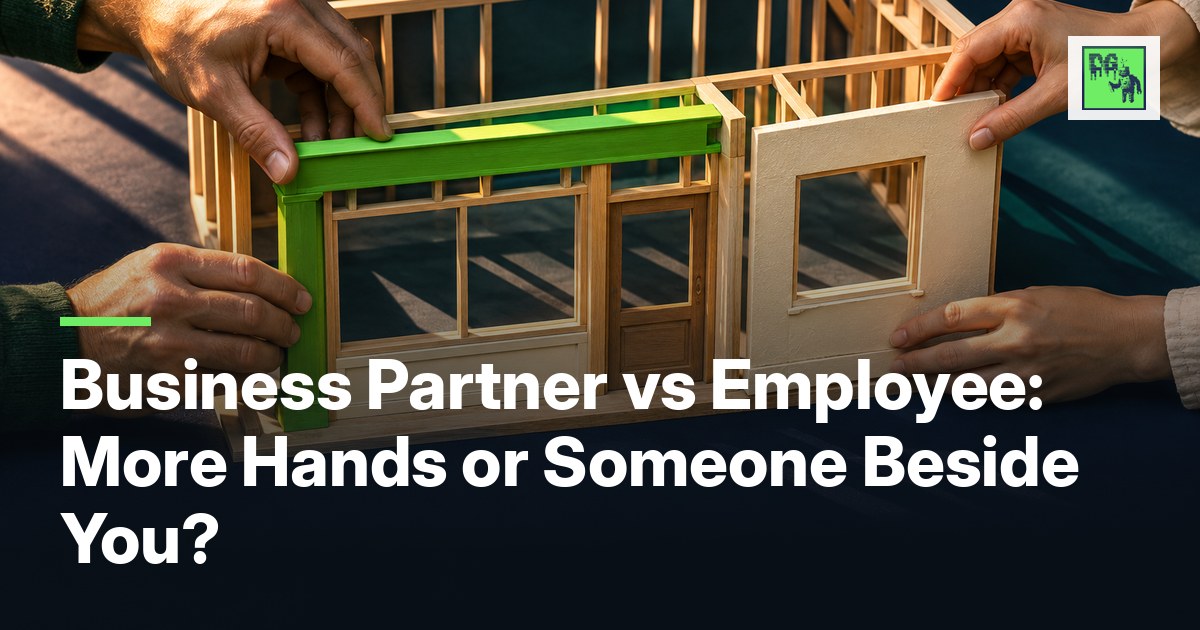
Business partner vs employee: choose an employee when you have a defined job that needs doing, and explore a business-building partner when the direction and execution need to be built together. The question is not who likes your idea most; it is what kind of responsibility you need someone to carry beside you.
A good addition makes your strengths more useful. The wrong fit gives you another job to manage.
That is a judgment about fit, not a knock on employees. A capable employee can be exactly what a business needs. But expecting somebody hired for a specific role to invent the whole business around that role is a different ask.
This article compares working relationships, not legal entity structures or ownership arrangements. Those terms need their own qualified advice and an actual agreement.
Business partner vs employee: what problem are you hiring for?
Picture a skilled service-business owner who cannot keep up with customer enquiries. There is already a clear service, a sensible way to quote the work and a reliable delivery process. The owner needs someone to handle a known responsibility consistently.
That sounds like a staffing problem.
Now picture an expert with a useful audience and several ideas for what to sell. The offer is fuzzy. Nobody has decided which customer it serves, how the customer buys or how the work gets delivered without consuming the expert's entire week.
Calling that an assistant role does not make it one. The owner may need someone who can help make those decisions and carry the work forward, not simply wait for a longer task list.
These are hypothetical examples, not customer stories. Their point is the distinction: extra capacity and shared business-building judgment are not interchangeable.
More hands can be the right answer
There is nothing small about doing a defined job well.
If customers already know what they are buying, the work is understood and the business owner can explain what good looks like, adding capacity may be the sensible move. Not every bottleneck calls for a new partnership.
The trouble starts when the job description says one thing and the expectation says another. You ask for content, then expect a new offer. You hire administrative help, then expect someone to decide which market to pursue. You ask somebody to follow a process that has never actually been settled.
That mismatch is worth fixing before you recruit anyone.
A role should not become a business-building relationship by surprise. Likewise, an owner should not have to offer a bigger relationship merely because a clear job has been left unfilled.
Be honest about whether the missing piece is time, a specific skill or somebody helping you make the business work as a whole.
A partner is not a more enthusiastic assistant
Being excited about the same idea is a pleasant start. It is not enough to build around.
The useful question is what each person contributes when the answer is not obvious. Can you disagree about the offer without making it personal? Can the other person explain what they would take responsibility for? Do they understand the strength you bring, rather than treating your business as a blank canvas for their favorite tactic?
There should be room for both judgment and execution. An endless stream of ideas still leaves the owner doing the work. Endless activity without commercial judgment can leave everybody busy while the important problem stays untouched.
A business-building partner should be able to discuss both. What are we trying to build, and what work are we each actually carrying?
That does not imply unlimited authority, automatic ownership or guaranteed results. It means the relationship deserves a clearer conversation than "we should do something together."
Watch what happens when the instructions run out
It is easy to look compatible while discussing possibilities. The more revealing moment is a real decision with competing priorities.
Suppose an expert wants to launch a new service while the existing customers still need attention. One person wants a bigger launch. Another thinks delivery needs fixing first. Neither position is automatically right.
What matters is whether the discussion comes back to the customer, the work and the trade-off. Can you choose a useful first piece together? Can each person explain what they own after the conversation ends?
This is not an invitation to demand unpaid speculative work. It is a reason to look for clear thinking, relevant examples and specific responsibility rather than treating chemistry as the whole interview.
The person who makes the best pitch is not necessarily the person you want beside you when something needs changing.
Keep the business advantage you already have
You might bring hard-earned expertise. You might have customers who trust you, a valuable audience or a service people already buy.
Those are starting points, not shortcomings to apologize for.
The question is whether the other person's contribution connects to that advantage. A specialist may be the right fit for one defined need. A broader building relationship may make sense when the offer, sales and delivery need to come together. Neither is better simply because it sounds more ambitious.
DRiPGATE describes its business-building partnership model around an existing strength and an agreed contribution from each side. That is a description of the model, not a promise that every applicant fits it or that every relationship has the same terms. Source checked November 11, 2026.
Choose the relationship that fits the actual work. Do not choose the biggest title and hope clarity arrives later.
Questions owners ask before choosing
Can an employee take real ownership?
Absolutely. A defined role can include substantial judgment and responsibility. The distinction here is not commitment or talent. It is whether you are filling an established role or agreeing to build a broader commercial opportunity together.
Does a business-building partner automatically get equity?
This article makes no claim about equity, legal status or compensation. Do not assume the word partner settles any of them. Scope and commercial terms must be explicitly discussed and agreed separately.
What if I am not sure which kind of help I need?
Start with the gap, not the title. Explain what already works and what keeps landing back on you. A useful conversation should make the missing responsibility clearer, even if the answer turns out to be a narrower role.
Bring the gap, not a perfect pitch
If you have expertise, customers or an audience and need help building the business behind it, you can explore a partnership with Patrick. The application starts a conversation; it does not create a contract or book an appointment. Application wording checked November 11, 2026.
You do not need to pretend everything is figured out. Be specific about what you bring and where you need somebody beside you.
About Patrick Grabbs
Patrick Grabbs, known as "the Internet's Middle Brother," is a Dallas entrepreneur and the founder of DRiPGATE. He partners with founders, experts, creators and local business owners who have the skill or the audience but not the business behind it, and builds the offer, the sales and the customers with them.
What do you need someone to build beside you?
Tell Patrick about your business and the gap you want help closing. Keep private customer details out.
Got it. We'll be in touch soon.